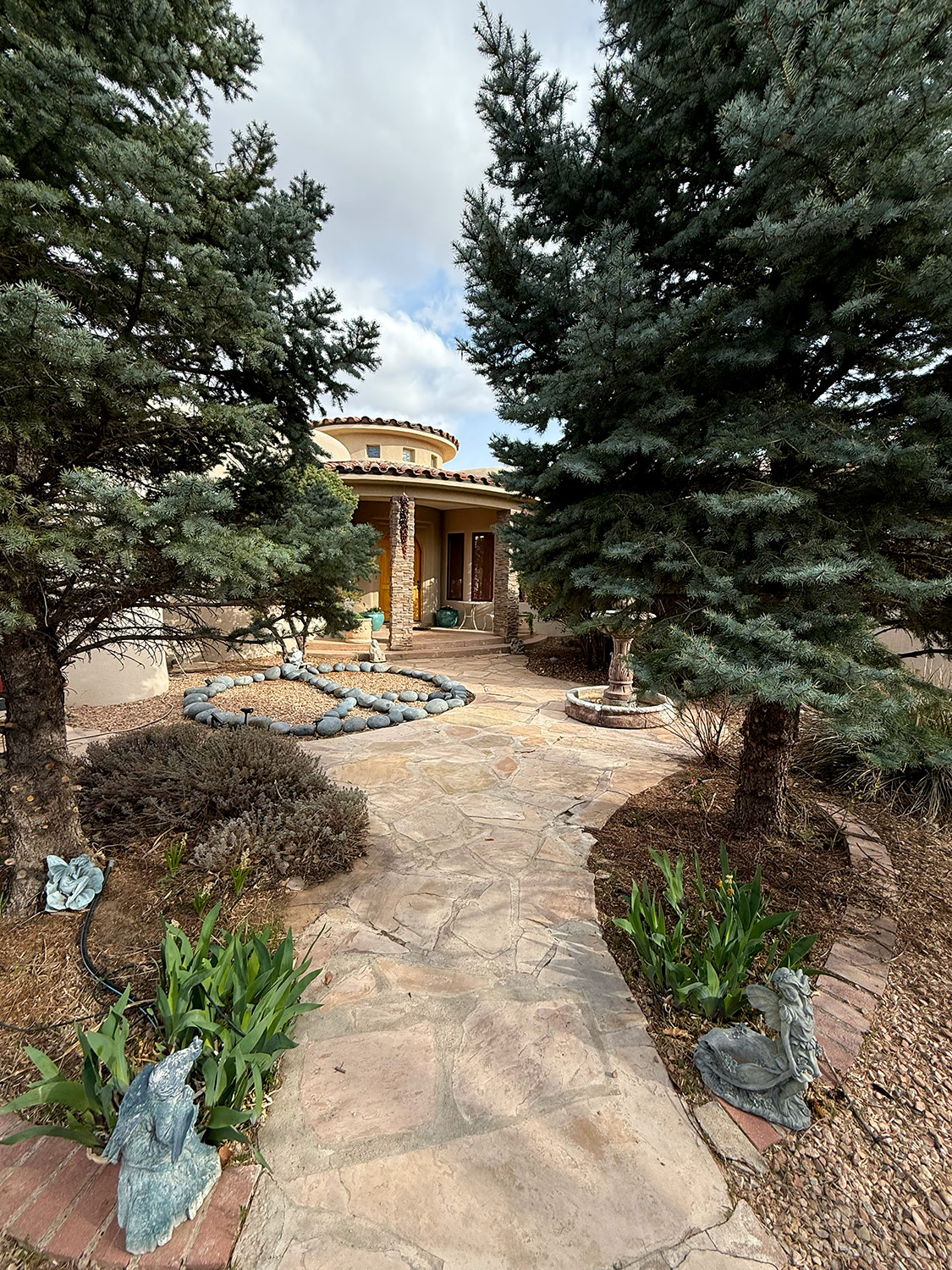
At Corrales Grief Spa at The Oasis in Corrales, New Mexico, a labyrinth rests on the grounds of the Garden of Grace, available to guests as a space for walking, for stillness, for a sacred moment. Its presence is not decorative, but intentional—an invitation to enter, to move, and to trust the path.
In it, there is only one path, without dead ends, wrong turns, or decisions to be made.
This is what distinguishes a labyrinth from a maze and what makes the labyrinth one of the oldest and most gently powerful healing tools in human history.
A Symbol Older Than History
The labyrinth is one of the oldest symbols in the human visual record. Labyrinthine designs have been found carved into rock faces, etched into pottery, and woven into architectural traditions across ancient Greece, Egypt, India, Scandinavia, the British Isles, and Indigenous cultures of North America, appearing across civilizations with no documented contact with one another, which is itself a remarkable fact about how universally this symbol resonates.
The most widely known labyrinth in Western culture is associated with the myth of Theseus and the Minotaur on the island of Crete, derived from a story that predates the Common Era and reflects a period when the labyrinth carried meanings of journey, danger, and transformation. The palace at Knossos, excavated by archaeologist Arthur Evans in the early twentieth century, is often cited as a possible source of inspiration for this mythological space.
But the labyrinth’s significance runs far deeper than any single myth. Scholars of Jungian psychology have described the labyrinth as a universal archetype, a symbol that appears across cultures and across time because it speaks to something in the structure of human psychological experience: the idea that the path through difficulty is not straight, that it turns back on itself, and that arrival at the center is possible if one keeps moving.
The Labyrinth in Spiritual and Religious Practice
Medieval Christians transformed the labyrinth into a devotional object. The most celebrated example, the eleven-circuit Chartres labyrinth, inlaid into the stone floor of Chartres Cathedral in France in the early thirteenth century, was designed to be walked as a substitute for pilgrimage to Jerusalem when travel was not possible. Walking it was a sacred journey: inward toward the divine, and back out into the world strengthened by what had been received at the center.
This distinction between the labyrinth and the maze carries particular weight in the Christian contemplative tradition. A maze is a puzzle. It is designed to confuse and disorient, with multiple paths, dead ends, and the possibility of becoming lost. A labyrinth is the opposite. It is unicursal—a single, continuous path that leads to the center and back out again. There is no possibility of being lost. There is only the journey.
The Chartres labyrinth survived and inspired a significant revival in the late twentieth century. In 1987, Lauren Artress, a canon pastor at Grace Cathedral in San Francisco, encountered the labyrinth through philosopher and cross-cultural scholar Jean Houston, who suggested it as a tool for healing amid the AIDS crisis. Artress went on to found Veriditas, an organization dedicated to the global renewal of labyrinth practice, and is widely credited with bringing the labyrinth into the contemporary therapeutic and spiritual mainstream.
What Happens When You Walk
The labyrinth is not a metaphor for healing. It is also a practice with a growing body of research on its psychological effects.
Research by Jocelyn Shealy McGee, Ph.D., at Baylor University’s Garland School of Social Work, identified three primary outcomes of labyrinth walking: a deepened sense of connectedness, with oneself, with others, and with something larger; a quality of transcendence that participants described as moving beyond ordinary awareness, and what McGee calls compassionate insight for social action, which is a renewed sense of purpose and capacity to engage with the world. McGee’s work, published in 2025, draws on qualitative data from walkers across a range of contexts and describes labyrinth walking as, in her words, “a prayer in motion.”
A physiological study examining labyrinth walking in youth and young adults measured autonomic nervous system responses during and after the walk. Results showed increased respiratory sinus arrhythmia, a marker of parasympathetic nervous system activation.
This indicated that the body moved from a state of stress toward a state of rest upon completing the labyrinth. The researchers concluded that the practice produced an overall effect of greater relaxation and calmness, and suggested that the labyrinth warrants further study as a stress-reduction tool in both medical and educational settings.
Separate pilot research examining labyrinth walking among health professions students found that participants organized their reported benefits around four themes: stress management, emotional regulation, contemplative practices, and life purpose. These are precisely the dimensions most disrupted by grief, loss, and major life transition.
We do not fully understand the mechanism behind these effects, but one hypothesis is structural: because the labyrinth eliminates the need for decision-making, and there are no choices to navigate, no wrong turns to recover from, the cognitive load that normally occupies the conscious mind lessens. Attention can settle into the body, into the breath, and into the sensation of walking itself. The result is something close to what researchers call the relaxation response: a physiological shift away from sympathetic activation and toward the restorative state that stress and grief so consistently interrupt.
The Labyrinth and Grief
Grief disorients, taking someone who once knew their way through the world into terrain devoid of familiar paths. The labyrinth offers something rare in that experience: a clear path that does not require you to navigate.
Eventually, without forcing it, you arrive at the center, you stay as long as you need to, and then you walk back out, on the same path, but changed by the crossing.
This is why the labyrinth has been used in grief rituals, memorial ceremonies, and end-of-life practices across many traditions. It offers a physical enactment of the journey grief asks of a person, not around the loss, but through it.
The Labyrinth at Corrales Grief Spa
The labyrinth in the Garden of Grace at Corrales Grief Spa is available to guests during their time at The Oasis. It may be walked alone or in the company of others. It carries no instructions, no required intention, and no correct interpretation. It offers presence and a space to hold whatever arrives.
If you would like to learn more about what a stay or session at Corrales Grief Spa might look like for you, Kristy would be glad to hear from you.
Frequently Asked Questions About the Labyrinth
What is the difference between a labyrinth and a maze?
A maze is multicursal: it has multiple paths, dead ends, and the possibility of becoming lost. A labyrinth is unicursal: a single, continuous path that leads to the center and back out again. There are no wrong turns and no dead ends. The labyrinth is not a puzzle to solve; it is a path to follow.
Where did labyrinths originate?
Labyrinthine designs appear in the archaeological record across ancient Greece, Egypt, India, Scandinavia, the British Isles, and Indigenous cultures of North America, among many other places. The symbol appears across cultures with no known shared connection, suggesting that it speaks to something universal in human experience. The most well-documented example in the Western spiritual tradition is the eleven-circuit Chartres labyrinth, built in the early thirteenth century and still walkable today.
What does walking a labyrinth actually do?
Research has documented a range of effects including reduced physiological stress markers, increased parasympathetic nervous system activation, improved emotional regulation, and a deepened sense of connectedness and purpose. At a structural level, the labyrinth appears to produce these effects partly by eliminating decision-making, which allows attention to settle into the body rather than remaining occupied with cognitive demands.
Do I need to have a spiritual practice to benefit from walking a labyrinth?
No. The labyrinth is accessible regardless of religious or spiritual orientation. Research participants across a range of backgrounds have documented meaningful experiences and measurable physiological effects. The labyrinth does not require belief—only the willingness to walk.
Can I walk the labyrinth at Corrales Grief Spa?
Yes. The labyrinth in the Garden of Grace is available to guests during their time at The Oasis. Reach out to Kristy directly to discuss a visit or stay.